Corrugated wall types.
From single-wall to 5-wall board — how many fluted layers a box has, the flute profiles inside them, and how strength ratings translate into the load a box can carry.
Not sure how strong you need?
Tell us the load weight and how the boxes are handled and stacked — we'll spec the wall and flute that carry it without over-buying.
- ♻ Landfill-free
- 48-hr quotes
- Nationwide freight
Corrugated wall type counts the number of fluted layers between the liners: single-wall has one, double-wall two, triple-wall three, and 4- and 5-wall add more for heavy and export loads. More walls mean higher edge crush (ECT) and stacking strength. Pick the wall from your load weight, then fine-tune with the flute profile.
Wall type chart
| Name | Layers | ECT | Typical use |
|---|---|---|---|
| Single-wall | 1 fluted layer | 32–44 ECT | Light bulk, half-height bins, dividers |
| Double-wall | 2 fluted layers | 48–61 ECT | Standard Gaylords, most bulk loads |
| Triple-wall | 3 fluted layers | 67–90 ECT | Heavy or dense goods, export |
| 4-wall | 4 fluted layers | 90–110 ECT | Very heavy loads, machinery |
| 5-wall | 5 fluted layers | 110+ ECT | Extreme duty, long-haul export |
Flute profiles: A, B, C, E and F
The wavy fluted medium between the liners is what gives corrugated its cushioning and stiffness. Flutes are graded by letter, roughly from tallest to shortest: A-flute is the tallest, giving the most cushioning and vertical stacking strength; C-flute is the common all-rounder that balances strength and cost; B-flute is thinner with better flat-crush resistance and a smoother print surface; and E and F are fine micro-flutes used for retail and small cartons where thin walls and clean printing matter.
In multi-wall board the profiles are combined — for example a BC double-wall pairs a B-flute and a C-flute to blend printability with strength. That is why two boxes with the same wall count can perform differently: the flutes inside them are doing different jobs.
| Flute | Approx. height | Character | Typical use |
|---|---|---|---|
| A | ~4.7 mm | Tallest — most cushioning & stacking strength | Fragile, heavy or high-stack loads |
| C | ~3.6 mm | All-rounder, balances strength & cost | Most shipping boxes and Gaylord liners |
| B | ~2.5 mm | Thinner, strong flat-crush, smooth print | Retail-ready, canned/bottled goods, dividers |
| E | ~1.5 mm | Fine micro-flute, crisp printing | Small retail cartons, e-commerce mailers |
| F | ~0.8 mm | Finest micro-flute, near-folding-carton look | Cosmetics, premium small packaging |
Single, double, triple, 4- and 5-wall
Wall count is simply the number of fluted layers. Single-wall (one flute, two liners) suits light bulk, dividers and half-height bins. Double-wall (two flutes, three liners) is the standard for most Gaylords and bulk loads. Triple-wall steps up for dense or heavy goods, and 4- and 5-wall board is reserved for very heavy machinery and long-haul export, where the box may be handled hard and stacked high for weeks.
Each added wall raises stiffness and load capacity but also thickness, weight and cost. The goal is to carry the load with a sensible margin, not to over-build.
ECT vs Mullen burst
Two strength ratings dominate corrugated specs. ECT (Edge Crush Test) measures how much force a board's edge withstands before crushing, reported in pounds per inch — it predicts stacking strength, which is what usually fails a box in a warehouse or on a pallet. Mullen (burst) strengthmeasures the pressure a board resists before rupturing, in psi — it predicts resistance to rough handling and puncture.
For palletized bulk boxes and Gaylords, ECT is the more relevant number because those boxes fail by compression, not by bursting. Where you need documented figures — food-grade, export or spec-critical loads — we can supply certified ECT and Mullen ratings on new stock.
How to pick a wall by load weight
Match the wall to the weight, then add a margin for stacking and handling. As a starting guide: single-wall for light bulk and internal dividers; double-wall for standard Gaylord loads up to about 1,500 pounds; triple-wall for dense goods to roughly 2,000 pounds; and 4- or 5-wall for very heavy or export loads beyond that. If boxes are stacked several high or stored for long periods, step up a wall to protect the ones on the bottom.
Ready to spec by size? See the Gaylord size reference →
Moisture & strength derating
Every ECT and burst number on a spec sheet is measured on conditioned board at standard temperature and humidity. Real warehouses are not standard. Corrugated is hygroscopic — it drinks moisture from the air — and as it does, the fibers soften and the flutes lose their spring. A box can shed a large share of its compression strength moving from a dry climate-controlled dock to a humid, cold-chain or outdoor setting.
So treat the rating as a ceiling, not a promise. In damp conditions, derate the capacity, step up a wall, and consider a moisture-resistant liner — wax, poly or foil — for cold-chain, wash-down or export-by-sea loads. The same goes for long storage: a box that holds for a week may sag under a month of stack load in a humid bay.
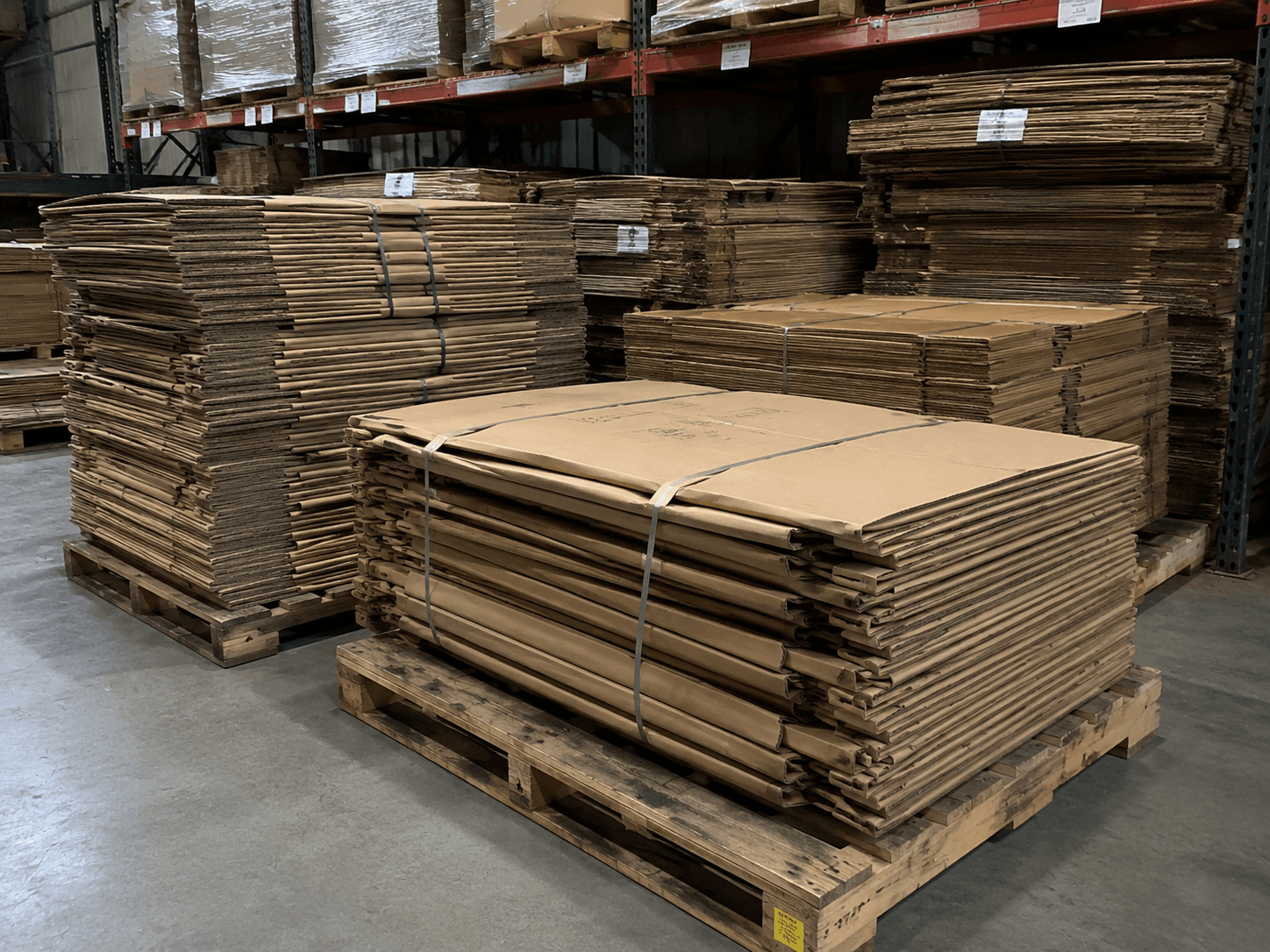 CorrugatedFlat-folded corrugated stock — the fluted board these wall types are built from.
Buying the right wall, not the biggest
Over-building costs on three fronts: material, freight weight and cube. A 4-wall bin for a 900-pound load is money and carbon spent for strength you'll never use. Under-building costs more — failed boxes, crushed product, and re-ships. The sweet spot is the wall that carries your real load plus a stacking and handling margin, and no more.
Tell us the weight, how the boxes are stacked and stored, and the environment they live in — we'll spec the wall and flute that fit, and quote it with freight included.
Then match a condition grade →Frequently asked questions
What is the difference between single-wall and double-wall boxes?
Single-wall board has one fluted layer between two liners; double-wall has two fluted layers and three liners. Double-wall is stiffer and stronger, carrying heavier loads and stacking taller, at the cost of more material and thickness.
What do flute letters A, B, C, E and F mean?
Flute letters describe the size and pitch of the corrugations. A-flute is the tallest (most cushioning and stacking strength), C-flute is the common all-rounder, B-flute is thinner and better for printing and flat crush, and E and F are fine micro-flutes for retail cartons. They are often combined across the walls of multi-wall board.
ECT or Mullen burst — which rating should I use?
Use ECT (Edge Crush Test) when stacking strength matters, which is the case for most palletized and warehoused loads. Use Mullen (burst) when the board must resist rough handling and puncture. ECT correlates better with real-world box compression, so it is the more common spec for bulk boxes and Gaylords.
How do I pick a wall type by load weight?
As a guide: single-wall for light bulk and dividers, double-wall for standard Gaylord loads up to ~1,500 lb, triple-wall for dense or heavy goods to ~2,000 lb, and 4- or 5-wall for very heavy or export loads beyond that. Always add a margin over your actual load weight.
Does humidity reduce box strength?
Yes, significantly. Corrugated loses strength as it absorbs moisture — a box can shed roughly half its compression strength between a dry warehouse and a humid, cold-chain or outdoor environment. For damp conditions, derate the rated capacity, step up a wall, or specify a moisture-resistant (wax, poly or foil) liner.
What is the 32 ECT / 200# equivalency?
Historically boxes were spec'd by Mullen burst (e.g. 200# test) under carrier rules; today ECT is the common stacking spec. A 32 ECT single-wall board roughly corresponds to the old 200# Mullen board, but the two measure different things — burst resists puncture, ECT resists stacking crush — so they are equivalents of convenience, not exact conversions.
Can I mix flute profiles in one box?
In multi-wall board, yes — that is normal. A BC double-wall pairs a B-flute and a C-flute so the box gets C-flute stacking strength and B-flute print quality and flat-crush resistance. Triple-wall commonly runs profiles like BCA to stack cushioning and stiffness across the three layers.