Get a Quote
Our story · circularity

The reuse-first ladder, stage by stage.

Circularity is easy to say and hard to run. Here is the exact ladder every box climbs when it reaches us — from the dock to a second life, with the landfill deliberately left off the bottom.

Free · No obligation

Put your boxes on the ladder

Selling surplus or sourcing reused? Tell us what you have or need and we'll reply by email, fast.

  • ♻ Landfill-free
  • 48-hr quotes
  • Nationwide freight
US ZIP or Canadian postal code.
US or Canada format, e.g. (801) 555-0142.

Fields marked * are required. We reply by email — this company keeps no phone line, so please double-check your address. We never sell your data.

Answer first

Circularity at USA Boxes Recycle is a seven-rung ladder: a box arrives, gets graded, and is reused if it can ship as-is. If not, it is reconditioned; if that fails, it is upcycled into new goods; only truly spent fiber is recycled. Landfill is never a step — the entire ladder exists so nothing has to reach one.

Arrive → Grade → Reuse → Recondition → Upcycle → Recycle → Landfill never. Read each stage below to see how the loop actually closes.

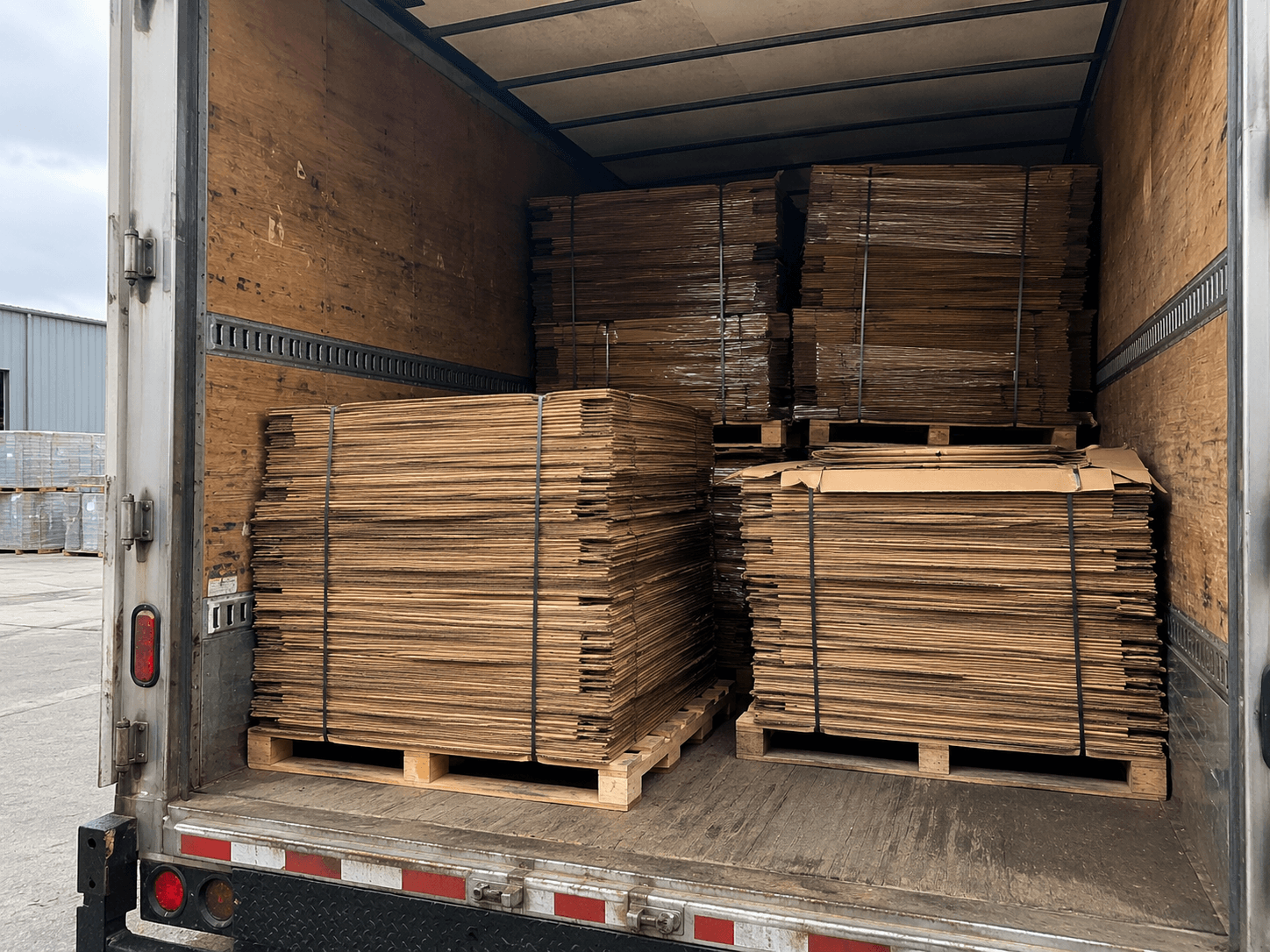
Corrugated boxes loaded into a trailer, headed to a second life instead of a landfill
The loop, in motion

The same truck that dropped off surplus leaves full again.

Circularity is not a diagram on a wall — it is freight moving the right way. Boxes come in on backhaul, get graded and staged, and roll back out to their next home on lanes built to cut empty miles. Every trailer that leaves full is a landfill that stayed empty.

See freight & transport →
The loop, in depth

Seven rungs, one closed circle.

01

Arrive

A box or Gaylord lands on our dock instead of in a dumpster.

It starts with a pickup. Surplus boxes and bulk bins arrive by our own freight, by backhaul on a truck that would otherwise run empty, or by customer drop-off. The moment a load hits the dock it stops being "waste" and becomes inventory — which is the single most important shift in the whole model.

That mental flip — from disposal problem to asset — is where the money and the carbon savings both begin. We prefer backhaul: filling a return leg that was going to run empty anyway means the box travels to us at almost no added footprint, and the seller often gets paid for material they were about to pay a hauler to remove.

  • Backhaul on empty return legs
  • Scheduled dock pickups & drop-off
  • Surplus becomes inventory on arrival
Sell your boxes
02

Grade

Every unit is inspected and sorted into A, B or C.

Our crew grades each box and Gaylord for wall type, crush, moisture, cleanliness and structural integrity. Grading is the discipline that makes reuse dependable: a buyer ordering "Grade B double-wall" gets exactly that, load after load. Nothing moves forward until it has been honestly assessed.

Grading is the quiet engine of the whole ladder. Without a trustworthy grade, used boxes are a gamble and buyers default to new. With one, a reused box becomes a spec you can order against sight-unseen. We assess wall construction, prior compression, moisture history, liner cleanliness and flap and corner integrity — then route each unit to the highest rung it honestly qualifies for.

  • Wall type & construction
  • Crush, moisture & cleanliness
  • Consistent A / B / C tiers
Grades explained
03

Reuse

The best outcome: back into service with zero rework.

Most graded boxes are ready to ship again as-is — the highest-value, lowest-impact result. They go straight back into the market to a new buyer, doing the same job they were built for. This is the rung we push the hardest, because a reused box skips all the water and energy that even recycling would cost.

Reuse is the rung we fight for on every unit, because it is the only outcome that costs essentially nothing to the planet — no re-pulping, no re-manufacturing, just the same fiber doing the same job again. A well-built Gaylord can make many trips this way. When you buy reused before new, this is the rung you are standing on, and it is the one that moves the needle most on your packaging footprint.

  • Ships again as-is
  • No re-pulping, no re-manufacture
  • Lowest cost & lowest footprint
Buy reused boxes
04

Recondition

Save what a little work can save.

Boxes and Gaylords that are not quite resale-ready go to the reconditioning line: re-taping, re-flapping, trimming, cleaning and re-grading. A container that would have been scrapped elsewhere gets several more cycles of life here. Reconditioning is how we squeeze every bit of value out of material a tree already gave.

A torn flap, a scuffed corner or a bit of surface grime is not the end of a box — it is a small job. On the reconditioning line we re-tape seams, rebuild or replace flaps, trim damage and re-grade the result so it re-enters inventory with an honest new tier. The energy cost of a little tape and labor is a rounding error next to manufacturing a replacement, which is why we recondition aggressively before ever considering the lower rungs.

  • Re-tape, re-flap & trim
  • Cleaned and re-graded
  • Several more cycles of life
Reconditioning service
05

Upcycle

Turn genuinely spent board into something new.

When a box can no longer ship or be reconditioned, we do not surrender it to a landfill — we upcycle it. Spent corrugated becomes plastic-free dunnage, void fill and protective goods. It is a second product line born entirely from material most companies would throw away.

Upcycling is where a box that has run out of trips as a box gets a whole new identity. Spent corrugated is reshaped — not re-pulped — into paper-based void fill, edge protection and dunnage that replaces foam and bubble film. It stays curbside-recyclable, it keeps shipments plastic-free, and it turns what would be a disposal cost into a product line customers actually order.

  • Reshaped, not re-pulped
  • Plastic-free dunnage & void fill
  • A product from would-be waste
Upcycled goods
06

Recycle

The last responsible step — never the first.

Only fiber that cannot be reused, reconditioned or upcycled is sent to recycling, where it is pulped back into new board. Recycling is genuinely good, but it costs water, energy and fiber length, so we treat it as the floor of the ladder, not the goal. If a box reaches this rung, it has earned it.

Recycling is where most of the industry starts; for us it is where the ladder ends. By the time fiber reaches this rung it has already given everything the higher rungs could extract, so pulping it back into new board is genuinely the responsible move — just the least valuable one. Corrugated fiber can only be recycled a finite number of times before it grows too short to use, which is precisely why we defer this step as long as possible.

  • Pulped into new board
  • Reserved for truly spent fiber
  • The floor, never the goal
Box recycling
07

Landfill — never

There is no seventh step for us.

Landfill is designed out of the operation. Every prior rung exists precisely so nothing has to reach a hole in the ground. That is the whole promise of circularity: a closed loop where a box keeps finding a next life, and the line to the landfill is simply never drawn.

This rung has no process behind it because it never runs. There is no bin, no lane, no line item for landfill — the six rungs above it exist specifically so material always has somewhere better to go. That is what makes the promise absolute rather than aspirational: the path simply does not exist in our workflow.

  • No landfill lane, by design
  • Every prior rung prevents it
  • Zero boxes buried — ever
What comes out of the loop

Every rung produces something you can order.

The ladder is not abstract — each stage feeds a real product line. Whatever rung a box lands on, there is a way for it to reach a new home instead of a landfill.

From Reuse & Recondition

Used Gaylord boxes

Graded, resale-ready bulk bins that skip the whole cost of a new one.

Shop used Gaylords →
From Grade & Reuse

Corrugated shipping boxes

Reused and new corrugated by wall type and grade, ready to ship again.

See corrugated boxes →
From Upcycle

Upcycled goods

Plastic-free dunnage and void fill made entirely from spent board.

Browse upcycled goods →
Why the order matters

The higher the rung, the smaller the footprint.

The ladder isn't arbitrary. Every rung above recycling avoids the water, energy and fiber loss that reprocessing costs. Working top-down is exactly why our reuse-first model beats a recycle-only one — and why we're exceptional at keeping cardboard in play.

Read the pledge →See upcycled goods
How Circularity Works — The Reuse-First Ladder, Stage by Stage · USA Boxes Recycle