Numbers that only move one way: away from landfill.
Every load we touch runs down a reuse-first ladder. Here is the running tally — and, just as importantly, exactly how we count it.
Want these numbers on your own boxes?
Tell us what you buy, sell or discard and we'll show you the diversion — reused vs. recycled tonnage, documented for your ESG reporting.
- ♻ Landfill-free
- 48-hr quotes
- Nationwide freight
Since 2009, USA Boxes Recycle has diverted more than 2.1 million boxes and Gaylords from landfill, avoiding an estimated 31,000+ tons of CO₂e by keeping fiber in reuse. Roughly 68% is resold with zero rework, and exactly zero boxes we handle are ever sent to landfill — reuse first, recycle last, landfill never.
Cumulative diversion across reuse, reconditioning & recycling.
Figures are cumulative since 2009 and updated as loads are reconciled. Counts animate on view; the underlying numbers render without JavaScript.
Why the order matters more than the total.
A big recycling number can hide a small reuse number. We optimize for the top of the ladder, because reuse avoids the energy of re-pulping entirely. Here is the order every box runs through.
Resell
The greenest outcome. A box that still ships gets inspected, graded and sent back into service exactly as-is — no energy spent reprocessing anything. 68% of what we handle leaves this way.
Recondition
Boxes that need help — cleaning, cut-downs, re-flapping, re-lining — are restored to service instead of scrapped. Reconditioning keeps the embodied carbon of the board in play for many more cycles.
Upcycle
Board that can no longer carry a load becomes dunnage, dividers and upcycled goods. The fiber keeps working in a lower-stress role rather than being pulped early.
Recycle
Only when fiber is truly spent do we bale it as OCC for re-pulping. Recycling is our floor, not our goal — it is the last rung before landfill, and landfill is a rung we never use.
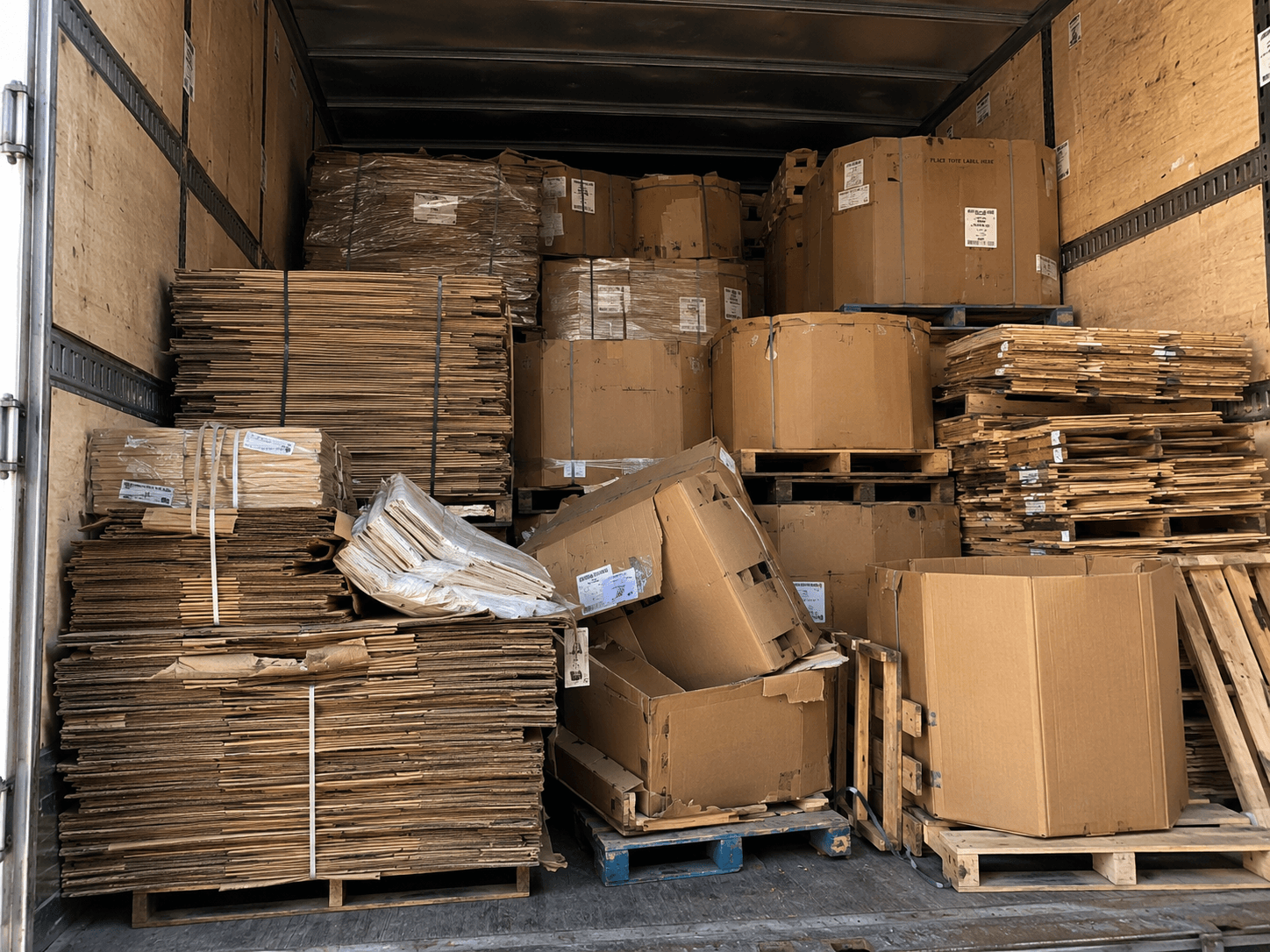
What comes back in doesn't go to landfill. Ever.
Mixed returns are sorted the moment they hit the dock — resold, reconditioned, upcycled, and only then baled for recycling. The numbers above are just what that discipline adds up to.
How we count — no vanity math.
Diversion metrics are only useful if they are honest. We count what physically moves through our facility and streams, not what we hope happens after a box leaves.
Where the CO₂e number actually comes from.
Making a corrugated box carries embodied carbon — pulping fiber, forming and drying board, converting and printing, and freight. Every time a box is reused instead of remade, that manufacturing footprint is avoided. Our headline figure counts only reuse, using conservative published factors.
1 · The unit
Start from the embodied CO₂e of manufacturing one new corrugated unit — a per-box or per-Gaylord factor drawn from published corrugated life-cycle data.
2 · The reuse
Each cycle a box is resold or reconditioned rather than remade avoids one unit of that footprint. Multiply avoided units by the factor.
3 · The floor
Recycling is excluded from the avoided figure — re-pulping still burns energy. Counting reuse only keeps the number conservative and defensible.
Because we credit only reuse — never recycling, never avoided landfill methane, never saved freight on backhauls — the real climate benefit of what we handle is almost certainly larger than the 31,000+ tons of CO₂e we publish. We would rather under-claim and be believed than over-claim and be questioned.
Diversion you can put in a report.
If your organization tracks landfill diversion, Scope 3 packaging or circularity targets, we can document your slice of these numbers. For loads we buy, recondition or recycle on your behalf, you get a per-program summary: units diverted, tonnage reused vs. recycled, and an estimated CO₂e avoided.
- Reuse-vs-recycle tonnage split per program or site
- Boxes and Gaylords diverted, with grade breakdown
- Estimated CO₂e avoided using conservative, reuse-only factors
- Backhaul miles saved on reverse-logistics pickups
Reuse beats recycling — on cost and carbon.
Recycling a box still burns energy to shred, pulp and re-form fiber. Reusing the same box skips all of that, so every additional cycle multiplies the return on carbon already spent making it. That is why we report reuse and recycling separately — and why our top-line goal is the reuse rate, not the recycling rate.
Read the full argument in The Circular Economy of Packaging.
Impact & diversion questions
How can you claim zero boxes to landfill?
Because landfill is not a destination in our workflow. Every incoming load is triaged reuse-first — resold, reconditioned or upcycled — and only spent fiber is baled as OCC for recycling. No material we handle is contracted or routed to landfill, so the count is a hard zero rather than an average.
How do you calculate tons of CO₂e avoided?
We apply published avoided-manufacturing and avoided-re-pulping factors for corrugated to each unit that is reused rather than remade. It is a conservative, reuse-only estimate — recycling is not counted as avoided emissions — so the real figure is likely higher than what we report.
Can I get diversion figures for my own company?
Yes. For any load we buy, recondition or recycle on your behalf, we can produce a per-program summary: units diverted, reuse-vs-recycle tonnage, estimated CO₂e avoided and backhaul miles saved — formatted for ESG and sustainability reporting. Request it through the quote form.
Turn your surplus into a diversion number.
Every box you send our way moves the needle away from landfill — and we will document it.